


In the last few releases, the Account Engagement product team has given us some amazing enterprise-level features for global marketing automation. We’ve seen the introduction of Einstein, External Actions and a more powerful infrastructure to back up larger datasets and complex operations. Global enterprise businesses are now choosing Account Engagement more and more. But how does a famously simple tool fit the bill for these multinational organisations?
As with most strategies, success with global marketing automation is born out of planning. The two key parts of this recipe are People and Structure. In this blog, I’ll be focusing on how the structure of your organisation can drive excellence in Marketing Automation.
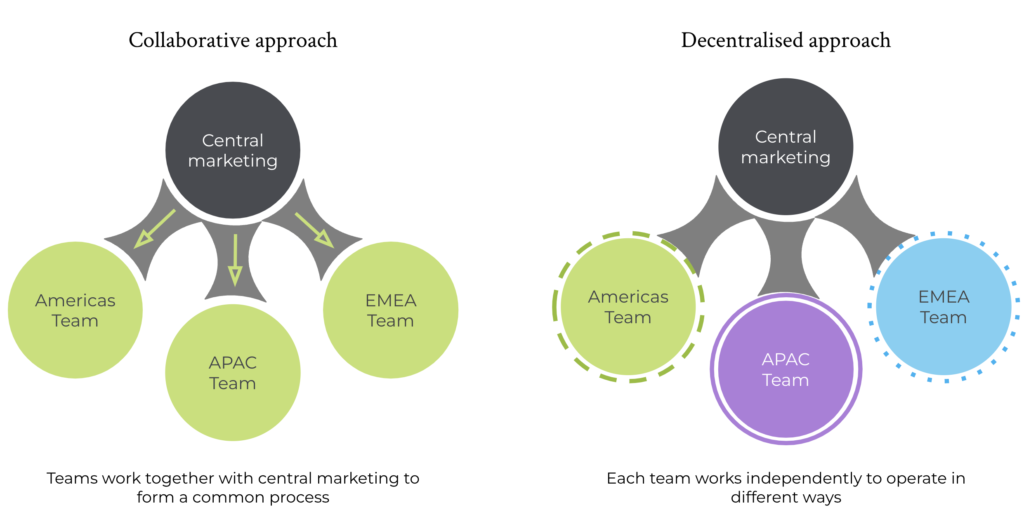
The key to structuring a successful global implementation of Account Engagement is defining ownership of the platform. The first step is to think about your overall approach to different areas of the platform. Will you opt for a collaborative, global approach or a decentralised, regional approach?
Collaboration AND decentralisation
First up, what does “collaboration and decentralisation” mean? These terms represent the two ends of the spectrum of ownership. In other words, the model for who owns what in your marketing strategy and the balance you strike between top-down central governance and regional independence.
Defining ownership is critical ensuring all the moving parts of your marketing automation platform work together. Poorly defined responsibility leads to duplication of effort, important details being missed, frustration amongst users, demotivation and ultimately, non-adoption.
Collaboration
The spectrum of ownership can be applied to any area of a business. The collaboration end focuses on areas of your strategy which must be globally consistent. This might look like:
- Central governance
- Top-down distribution of process, content or resources
- Consistent implementation across all global teams
- All users working together to adopt a common approach
In the marketing automation context, this might be your data handling policies or your core platform integrations.
Decentralisation
At the other end of the spectrum, you might implement a decentralised approach to strategy. This looks like:
- More flexibility for users in execution
- Regional or cultural differences
- Central guidance and support .
Newsletters or holiday campaigns are a common example of decentralised marketing automation.
Applying ownership to Marketing Automation
We’ve seen each end of the ownership spectrum, but it’s not quite as simple as picking a side. You can’t just say “We’re going to be decentralised” or “Let’s opt for collaborative strategies”. There’s a huge grey area, as what works for one element of your marketing automation strategy won’t work for another. So, you may need to be flexible. Ownership of each area is a spectrum and each organisation will fall on different parts of this scale. This position may even shift as time goes on and the market changes. Typically, as organisations grow there is tendency towards the decentralised end, but this is by no means a rule.
Spectrum of ownership
In the diagram below, you can see examples of what each end of the spectrum looks like when applied to different areas of Account Engagement. Try plotting where your organisation sits on the scale for each area. You will probably find you land somewhere more in the middle than right at either end.
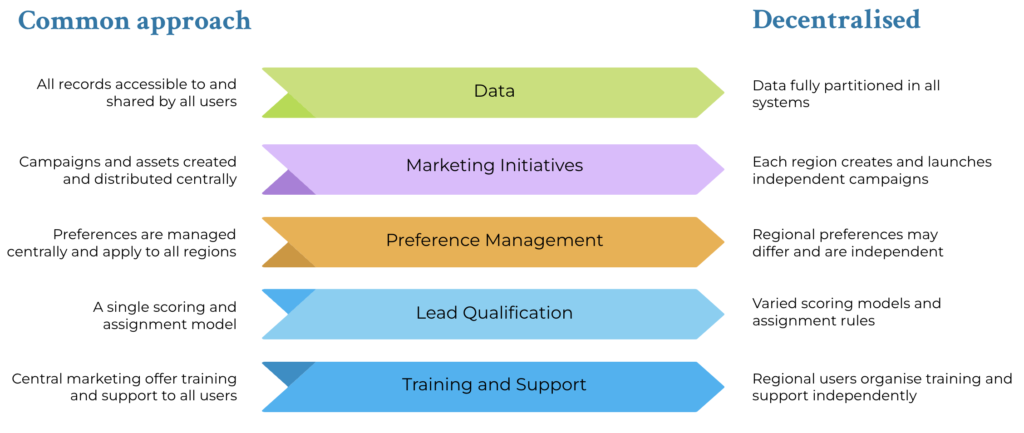
Let’s look at an example to illustrate why that is. When it comes to data, you can have an entirely open sharing model. All users can access, segment and market to all records. This is a simple structure but can raise governance concerns, particularly around regional privacy laws and capacity for human error.
On the other end, you could have a totally segregated model, with multiple distinct partitions of data. This means each team “owns” their own portion of the data and users can only access and market to data which “belongs” to their team. This creates more confidence from a governance and security perspective, but can introduce challenges with architecture, permissions and duplicates, potentially creating unnecessary technical debt.
So perhaps you land somewhere more in the middle. This might mean having some way of controlling which regions have access to which data but with some degree of flex where it makes logical sense for a record to be shared. For example, a Prospect lives and works in the US but attends an event in Germany. Both the Americas and EMEA teams are likely to need to communicate with that record without creating duplicates.
How to define your ownership strategy
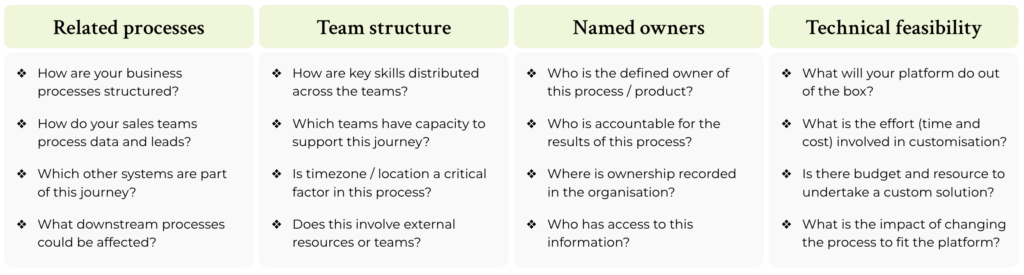
If you haven’t yet mapped out your ownership strategy, use these points and the questions in the table below to help you understand where your company falls on the scale for each area of Marketing Automation.
-
Related processes
Parallel or downstream processes could have a big impact on how you are able to structure your marketing automation strategy. For example, if your sales data is heavily locked down, an open marketing data model may not be appropriate or even possible.
-
Team structure
You may want to have centrally created email templates, but if there is only one central marketing manager with limited capacity, this creates a bottleneck and decentralising template creation may be a better option.
-
Named owners
You may already have Product Owners or BPOs in your organisation but if not, it’s important that the buck eventually stops with someone. Then, once you’ve decided on an approach, it’s also critical that everyone knows who those owners are. You must not get into a situation of users being passed from pillar to post because everyone thinks someone else is responsible for this field on the preference centre or that newsletter list. Take ownership, write it down and share it. With everyone.
-
Technical feasibility
It’s important to understand what the tools you have will do out of the box vs. what you’ll need to create custom. Although every Business Analyst will tell you not to solutionize when defining your objectives, you do need to keep a foot on the ground and make sure where you land is technically possible. If you’re ready to undertake a significant project to heavily customise Salesforce and Account Engagement to achieve exactly what you need then great. But if you don’t have the budget, resource or timeline to do that, you’ll have to colour within the lines a little more carefully and take that into account when defining your strategy.
Once you have defined ownership, it’s much easier to implement a platform that will deliver the results you want. And this applies right from the big structural decisions – whether to use Business Units – all the way through to the detail of execution – who creates the Dynamic Content for your email campaigns.
Summary
Trying to implement Account Engagement (or any Salesforce product) without a clear understanding of how you want it to work from a business perspective or what success looks like is a recipe for disaster. Understanding how you want to approach key areas of Marketing Automation will help ensure you get the platform delivering on that strategy more quickly and more effectively.
If you take nothing else away from this blog post, please remember this: Strategy comes FIRST. The technology is there to support and deliver on that strategy. Define who owns what in your marketing strategy BEFORE you try to design your architecture.
And if you’ve enjoyed this post, you can watch my full presentation of this topic at MarDreamin’ and here are some other resources you might find useful: